 n the first day of Spring my thoughts always lead me to the garden.
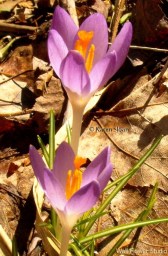
One of the first flowers to greet me after a long winter is the lovely Crocus.
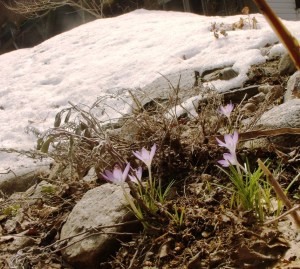
With petal colours varying from white, purple, yellow, and even striped, this small perennial bulb, (corm), planted in autumn for its spring show, originates from the Alps, and offers abundant blossoms that brighten up the beds, often while other parts of the my garden are still heavily laden with snow.
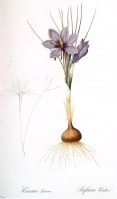 Ancient legend relates Crocus as an unfortunate lover. The myth centres around his unfulfilled and tragic love for Smilax, a woodland nymph, also transformed but in her case, as a brambly vine. His sorrow it is said, awakened sympathy from the gods who aided his metamorphosis into what we now know as this dainty spring flower.
According to old lists containing flower meanings, the Crocus flower is equated to both ‘Spring’ and ‘cheerfulness’. And why not after a long, dreary winter?! Both meanings seem quite appropriate!
 Out from the heart of the Crocus,
There leaped to my heart a song,
It was as though an angel
Had borne the word along,
And its message drew and held me,
Until my soul was strong.
~ E.M. Hill
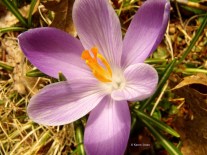 Saffron, the stigma from Crocus sativus is a very expensive spice. Along with being a food additive, it scents perfumes, cosmetics, and is a component of traditional medicines. Studies show it works as an anti-carcinogentic, boosts the immune system, and is an antioxidant.
 Shown on frescoes dating from 1700 B.C., it’s no wonder this flower has been cultivated and harvested since ancient times in the Middle East, North Africa, India, and throughout the Mediterranean region.
In any case, with three feet of snow still to melt in my neck of the woods, I’ll think of this flower, and others, biding my time until I get to enjoy their presence once again.
Happy Spring!
- Turner, Cordelia Harris, ‘Cyclopedia of practical floriculture’, 1884
- Redouté, Pierre Joseph, 1759-1840 (Artist), 1805 – 1816, ‘Les liliacées’, Paris, Chez l’Auteur
-
 Hill, Everett Merrill, 1909, pg. 10 – The story of the crocus
 - Henry, George Liddell, Robert Scott, A Greek-English Lexicon, on Perseus
- Kew Science – Crocus L., Sp. Pl.: 36 (1753).
- Iranian Journal of Basic Medical Sciences – Survey on Saffron in Major Islamic Traditional Medicine
- Saffron gatherer, fresco, Akrotiri, Greece – Wikipedia
- Saffron gatherer, Minoan reproduction 1700 BC
- Richard Folkard, ‘Plant Lore, Legends, and Lyrics’ – Project Gutenberg
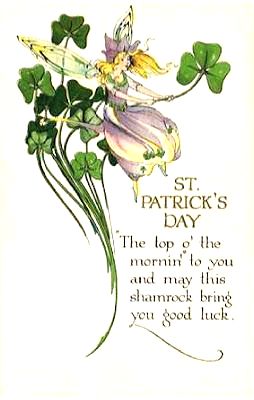
 By the same token, a clover with three leaves has symbolism, too. According to Pliny, it’s connected to the Holy Trinity. In addition, clover was used to make a salve against snake bites, since snakes represented Original Sin, and encouraged by that dastardly serpent in the Garden of Eden. Here, each leaf represents a good deed. In this case:
 Several years ago, I was lucky enough to find a four-leaf clover. I pressed it between the pages of a book, and since then its sat, on one of the bookshelves in my house. Now that I’m writing this post, I’ll have to search for it.





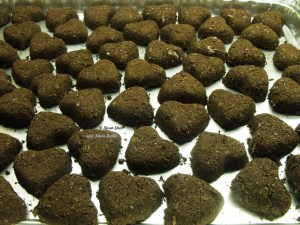


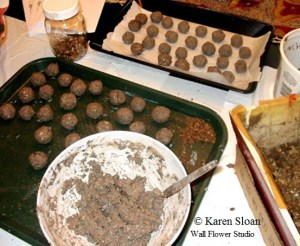
 Next step is to add water. Not too much, or too quickly, but enough to make the mixture damp. Stir it in slowly. If the mix is too dry, it won’t hold together so add a bit more. If the soil and clay become overly wet, the seeds will sprout before your finished seedballs get a chance to dry, which means you can’t store them to use at a later date. If the clump holds together, but won’t ooze water if you squeeze it, then that’s the perfect consistency.