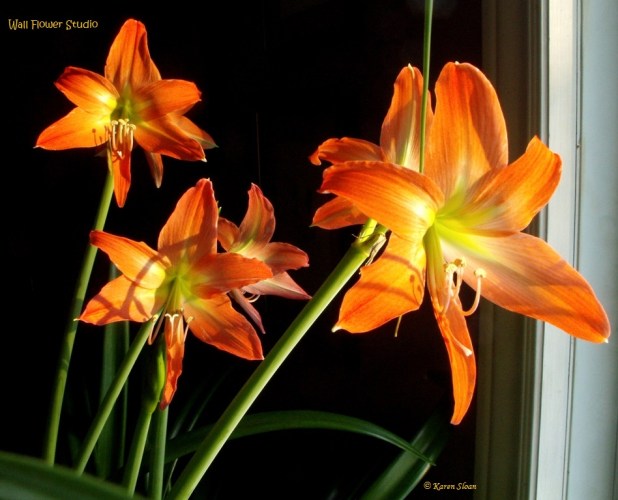
How to grow, pollinate and harvest seeds from an amaryllis – It’s very easy!

amaryllis-vittata-february-2015pistil-and-stigma-for-pollinating-the-amaryllis-karen-sloanPollinating and saving seeds from Amaryllis is very simple. All you need is a light touch.

Step 1: Collect some pollen, (gently), on your finger from the stamen. (see next photo)
Step 2: Dust it lightly on the stigma.
This should be done when the stigma (Pistil) is completely open.

Just a note: Some people use a paint brush to transfer the pollen, but this is not a requirement if you’re very gentle.

I don’t pollinate any flower with its own pollen. I’ll use the pollen from one flower to pollinate another .

seed-pod-developing-on-the-amaryllis-karen-sloan-wall-flower-studio

Unripe seed pod

This is a seed pod that develops not long after, from the pollinated flower that dies back.

Let it mature and turn brown. Then the seed head is ready to harvest.

amaryllis-seed-pod-opening-copyright-karen-sloan-wall-flower-studio

Seed pod is ready to harvest.


Many people ask me how to bring an Amaryllis  into bloom again…  Here’s my advice:

Don’t dig up your bulbs and stick them in the closet in the fall.  Don’t do it. It doesn’t happen that way in nature!

Why anyone started promoting such fiction, I’ll never know.

Seriously, I can’t tell you how much this myth irritates me, and every year I see gardening articles perpetuating this falsehood, repeating it verbatim like parrots, likely by writers who haven’t actually accomplished what they’re proposing you to do..

Because of that, it’s no wonder so many people tell me they’ve given up growing these beauties and can’t get a bulb to re-flower the next year. Purely because something so simple has been made to seem so very complicated…. There’s my rant for today!
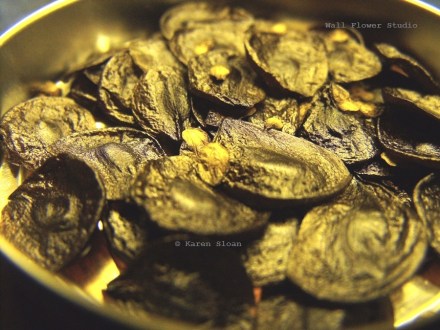
amaryllis-seeds-karen-sloan-wall-flower-studio

Freshly harvested, plump amaryllis seeds

In any case, bulbs have an internal clock that works very well, with or without our help.

As long as the flower stalks are allowed to die back naturally after flowering, and there has been sufficient water, light and food over the course of the year, (I only give them a bit of very diluted coffee or tea once a month), then you have the secret to getting them to flower again.

amaryllis-wfsMy amaryllis is 130 years old.

It was my originally my great-great grandmother’s plant, a true heirloom, and I cherish it!

It blooms every year, and sometimes twice. I can tell you, it has NEVER seen the inside of a closet!

Treat it as you would any houseplant, all year long, but ease up on the watering in November.

Don’t let your plant completely dry out, but water it once per month until a flower bud starts to emerge. Then water every 10 days or so. After the flowers finish, let the stalks die back naturally. This is very important as this is what provides the bulb with the energy to produce a flower next year… 

If you don’t like the look of the plant while it’s in this semi-dormant state, put it in a room where it’s not so visible.

Leaves will die back too, and watering should be lessened again ‘til  mid March when the sun gets higher in the sky, and you’ll see an abundance of new foliage. Water more often, as the cycle has begun again.


Handy hints for starting seeds – An easy DIY for any gardener

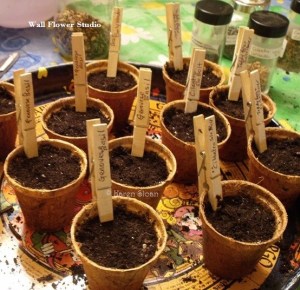
Starting seeds - clothes pin label at wall flower studioWhen you’re in a pinch, pardon the pun, and need some quick, inexpensive, yet effective labels for starting those seedlings, I’ve found clothes pins to be the way to go.  Simply write the variety of seed in the container on the clothes pin and clip it on the pot.

When the time comes to plant your seedlings in the garden, the clothespin can be switched to a bamboo stake and stuck in the ground.  Of course, they can be decorated too, and you’ll find a plethora of ideas on Pinterest, but to be honest, other than Martha Stewart, who actually has time for that?!

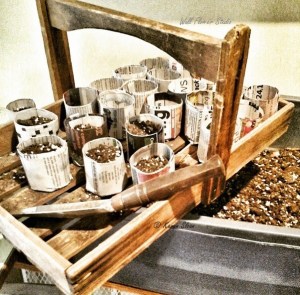
newspaper pots at wall flower studioAlso, I like to make my own newspaper pot containers to start my seeds in. Not only am I recycling, but the whole enchilada can be planted in the ground, when the time comes, which means those tender roots won’t be disturbed. Many plants do not appreciate being repotted or replanted.

Since the newspaper will break down in the garden, there’s not muss and no fuss. My kind of gardening.

Happy planting!


DIY – Making suet balls to feed our feathered friends!

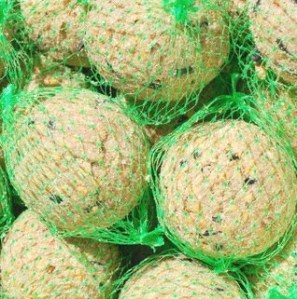
Feeding our feathered friends in winter can be fun, easy, and economical when you create your own homemade suet balls!  

Suet balls blog 1Ingredients:

-1 pound lard or fat
– 3/4 cup peanut butter
-1/2 cup flour
– 1/4 cup cornmeal
– 1 cup sugar
– approximately half a loaf of bread crumbs
– 1-1/2 cups of mixed seeds, nuts and chopped dried fruits


Directions:

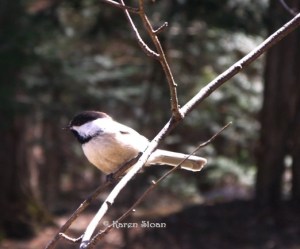
Chickadee at Wall Flower Studio - copyright Karen SloanMelt the lard and peanut butter over low heat. Mix flour, cornmeal, and sugar and stir in.
-Add enough bread crumbs to absorb all liquid.
-Add fruit, seeds, and nuts as desired.
-Pour into a 9 x 5″ bread pan (lined with plastic wrap), or pour into suet cake molds.(molds can be saved from store-bought suet.) -Allow to cool completely.
-Keep refrigerated or in a cool place like a basement.

One batch makes about four cakes.

When you’re snowed in, (as many of us were last week here in Ontario), why not create a treat for the birds?! Kids love to help with this too – Have fun!

Sharing a miniature Fairy garden DIY – Terrariums and furniture for the ‘wee folk’!

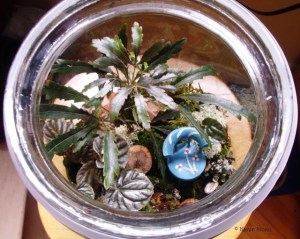
Fairy Terrarium with blue chair - Wall Flower Studio Karen SloanOne of my lovely customers ordered a Fairy garden in a terrarium. They requested that it be kept simple. For a container, I used a large apothecary jar. These offer ample room for soil, plants, charcoal, rocks, pebbles and moss that make up the wee garden.

The finished creation includes a small Peperomia caperata and a False aralia (Dizygotheca elegantissima). Sheet moss and lichens from our yard were added, along with some wooden ‘stepping stones’ to offer the illusion of a  pathway through the enclosed garden. Last but not least, the wee blue chair.

Fairy terrarium blue chair from above

After our last workshop here at the shop, there were a lot of twig and branch scraps on hand. That worked out well because I cut up all of the long twigs into smaller, more usable pieces. I also had some of the oak disks, (branches cut on their side, like a loaf of bread!), which work well for seats and tabletops.

fairy furniture chairs 1


Here are the first 3 chairs created at the kitchen counter. With glue gun in hand, I rifled through the twigs, and came up with 2 wee chairs and a table. It’s fun to try different styles, so one is a somewhat traditional style chair, and the other, a funky recliner!

I dislike seeing the strands of glue that you just can’t get away from when using a glue gun. I refer to them as ‘spider webs’. Hold your creation up to the light and pull those off. And, to hide any glue bumps, add a bit of moss to cover it up. Moss and lichens are great for disguising any of those unsightly mechanics.

finished fairy garden furniture Karen Sloan benchThey say the ‘devil is in the details’, but that’s the fun part! I had a couple of tiny little cuttings from a couple of twigs that ended up on the table as drinking cups. Being a floral designer, a small table arrangement was a must! Putka pods and dried Pee gee hydrangea seed heads worked well to create a tabletop bouquet.

finished fairy garden furniture Karen Sloan 22
After my bench and chair grouping was finished, it was on to bedroom furniture. First a night table, chair and bed! Again, more moss, which gives it a very natural ‘gardeny’ feel, along with paper birch that was lying on the ground in our yard. Birch bark makes terrific pillows and duvets! Just a note, I never rip the bark from the tree.

Fairy night table, bed and chair. Wall Flower StudioSuch fun!

Well, it’s back to the glue gun for me! I’m having too good of a time to stop now, but wanted to share.

I hope you’ll enjoy making your own miniature creations! If you’re located in Ontario, Canada and you’re interested in one of our upcoming workshops, please message me via the contact form below for more information. Thanks!

Wishing everyone a very happy week. ~ Karen

← Back

Thank you for your response. ✨


Amaryllis blooms from seed to stalk – #FloweringFriday

Amaryllis vittatum - Wall Flower Studio 2016

Amaryllis ‘vittata’

Amaryllis in bloom Jan 2016 Wall Flower Studio - Karen Sloan

Amaryllis vittata – I pollinate these flowers by hand, lightly dusting the pollen from the anther of one flower on to the stigma of another.  I  look forward to harvesting the seeds every year and growing new plants!

Amaryllis Seed Pod opened wfs (1)

Seed pod pops open by itself.

floating Amaryllis seeds for viability - Wall Flower Studio

Floating amaryllis seeds in water can help to tell which ones are viable. I’ve found it easy to tell, just by how plump each one is.


It was 6 years before seeds I planted actually flowered. Admittedly, there is nothing more thrilling than to see that stalk emerge from a bulb you’ve grown from seed. Patience is likely the biggest ingredient!

Happy Flowering Friday!