The Red Fox – A fabulous forest-lurker, neighbour, and totem animal.

Fox hunting for voles and mice.

Our backyard is a special place because of the abundance of wildlife in our neck of the woods. I am extremely fortunate to witness a diversity of animal/bird species who wander through on a regular basis.

One of my favourite visitors is the lovely Red Fox, (Vulpes vulpes).

These solitary hunters are intelligent, opportunistic omnivores, about the size of a small to mid-sized dog, and they rather remind me of a cat because of the way they play with their food, tossing the soon to be meal, (voles & other rodents) in the air with abandon, just before ending this celebration to seriously chow down on their catch.

Like many of us humans, the red fox prefers a diverse habitat! For them, that includes farm fields, forests, the edge of thickets, and even urban settings, where like the racoon they also thrive. From my experience in a rural setting, they hunt in and out of these habitats, which describes our backyard, and is likely why I see them so often.

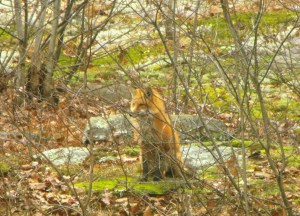
The adult red fox has a year-round coat of red that is absolutely striking to see in the winter, as you can see it here in contrast with snow.

Yes, there are some people who find satisfaction by wearing these beauties on their own backs. I’m not one of them and prefer to see the animal alive and well, in its own coat. Luckily, I don’t yet carry tomatoes & won’t pelt, (pardon the pun) fur wearing folk. However, I will offer an unequivical icy glare and judge you in a negative light. But, I digress…
Fox with mange.

Foxes are shy animals. They’re mainly nocturnal, but occasionally one will see these non-aggressive creatures during the day. If you see a fox during the day, it doesn’t mean that they are diseased with rabies or mange, though that can be the case. It more likely it means food may be more available for them during daylight hours in their respective environment.

If you’re interested in animal lore and totem animals like I am, there is a phenomenal amount of information available, making the fox an interesting subject to read about in many folkloric and mythic tales.

Consider the term “to outfox“, which means “to beat in a competition of wits”, similarly to “outguess”, “outsmart”, and “outwit”.  If you consider Aesop’s Fables from classical antiquity to Beatrix Potter‘s anthropomorpic stories, there are numerous stories involving a fox in popular culture throughout history.

Fox focus

Within the spiritual realm, they’re considered figures of cunning or trickery, or as a familiar animal possessed of magic powers and transformation.

As for having the lovely fox as a totem animal, it suits me well.

According to many who’ve interpreted the fox as a totem animal messanger, a fox will communicate its presence in order to offer the advice that you should think outside of the box. They also show us how to focus on our goals, and to use our creativity in our approach to current circumstances.

My feeling is that the fox encourages us to be aware of our own habits, (good or bad), adapt to our environment using all of our resources, and that we should refrain from certain distractions that may lead us off course when we want to realize a goal.

In any case, the Red Fox is a wonderful creature and participant in the planet’s food chain. They’re an animal that deserves our respect, and it is a real gift to see them in nature.
 

Home-Grown and Wildcrafted Smudge Sticks: Plant List and Recipes

Dana's avatarThe Druid's Garden

Basket of newly made smudge sticks Basket of newly made smudge sticks
Creating homemade smudge sticks with local ingredients is a wonderful activity to do this time of year.  As the plants die back, you can harvest whatever you aren’t using for other purposes and create a number of beautiful smudges that can be used for many different purposes: clearing, honoring spirits, protection, setting intentions, letting go, bringing in, preparing for ritual or mediation, and much more.

A few years ago, I wrote an initial post on homemade smudge sticks using local ingredients–this has become my most popular post on my blog.  Given that, I wanted to offer a follow-up post with some additional information and share a few smudge stick recipes for specific purposes. For initial instructions on how to make your sticks, please see my first post.  This post expands the plant list that you can use to make smudges and also offers…

View original post 2,497 more words

The Spirit Garden – An examination of life through flowers and plants

When one tends a garden, one tends to contemplate life. It’s very simple. Sometimes this examination is purely on a physical level; i.e. the plants right in front of our face. Other times it’s a more of a philosophical nature, one that reaches beyond the border of our property, nurturing our senses towards self introspection, leading to the creation of a spiritual garden.

If nothing else, gardening has taught me much. Not just about myself, but many life lessons have been transferred from plants to this person.

When  one views the world as a garden, one is more apt to engage nature with all the senses, as well as the mind and heart. Simply by observing and engaging in what nature has to offer, people have the ability to grow, not unlike a garden.

  • Equate weeds to negativity and flowers to the good things in your life. Take some time and pull the weeds out or they’ll spread, choking out all the flowers you wish to flourish.
  • Equate flowers to human beings. A diverse garden with many types of plants is worth celebrating and exploring. Can anyone, gardener or not, imagine a plot consisting of only one type of flower? How utterly boring.
  • Equate your garden to where you’ve been and how far you’ve come. A garden never stays the same and like life, change is inevitable.
  • Some plants wither and die. Chuck ’em in the compost and move on. Sometimes nothing will keep them alive. That goes for some relationships, too. People are really like flowers and will add joy and happiness to your garden, and not take it away.
  •  Corporate gardens are easy to spot. Usually heavily manicured, clipped, and planted overnight with annuals for instant gratification, they reside in front of many a sterile building, appearing like oppressive backdrops touting perfection, which is not possible in reality. They lack creativity and offer little or no benefit to local wildlife or sustenance for pollinators. What does bloom is dead-headed, discarded, and never allowed to set seeds for next year. They devolve in to a barren environment for most of the year, and tall poppies need not apply.
  • Cutting back taller flowers will not make the smaller ones look better.
  • Stay connected to your roots. Many a plant in my garden can be traced to a memory, a friend, a family member who may no longer alive, or a beloved place I can no longer visit. Nurturing those plants keeps those memories alive!
  • Every plant has its season. Enjoy them as they bloom. Live in the moment, as does each plant. Know that when it has finished blooming for the time being, it will be back next year to enjoy all over again.
  • Spending time in nature is healing. Don’t just work in the garden. Take the time to sit and enjoy the effort you’ve put in to it.
  • A garden won’t grow without water. Sometimes in life it rains, but this is good for the garden, and the sun will shine again.
  • Some people will not like your garden. That’s okay! Each garden offers the personality of the gardener. If they were all the same, the world would be a very boring place indeed.
  • The power of contemplation originates in abandonment of self. For example, if I’m feeling down or dwelling on something, I go to the garden. My thoughts stop inserting themselves and my focus is on what’s in front of me instead of what was troubling me. Gardening really is like burying your troubles in the dirt!
  • Gardening is a living canvas. As an artist who could not paint for several years, I found another way to be creative by designing my garden, and others, which offered an alternative outlet to explore all kinds of ideas, colours, textures, all the while offering inspiration to get back to painting when the time was right!

Shall add to this as I go along!

Would love to hear your garden thoughts.

Thanks for visiting!


Linaria purpurea – Bestowing some love on an underrated North American native perennial plant

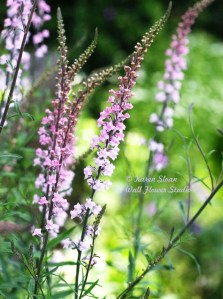
Linaria purpurea is a hardy perennial. This lovely native plant displays signs of life in my garden very early in spring. Its hardiness level is zone 3 USDA, or zone 4 if you’re in Canada.

An easy to grow specimen, I enjoy it because of the blooms that look like dainty miniature snapdragons.  The ‘wispy-ness’ of the whole plant, along with foliage that makes it appear much more delicate than it actually is, sways disarmingly in a warm summer breeze!

As an upright self-seeding perennial, every year I am able to collect literally hundreds of seeds from this plant. Having said that, Linaria doesn’t spread in what some may call a nasty way, like Phytostegia for example, as purple toadflax is easy to remove if they start sprouting where they’re not wanted.

The bees and butterflies are very attracted to Linaria. I don’t think I’ve ever viewed this plant during its tenure without some type of pollinator making a visit!  What really makes me happy though is that the Deer never graze upon them, even though there are other plants right beside them that are often chomped upon, hostas and a giant blue Lobelia, for example.

This is one plant that will bloom for months. The flowers begin in early July and continue until frost, and works well in combination with andy other plant material.

Seeds should be sown at approximately ½’”depth, and spaced about 4” apart. The plant forms little clumps which are easily divided, placed in other spots of your garden, or shared with friends!

The location where it seems quite happy in my garden is a sunny spot with dappled shade, however it enjoys full sun or alternatively, even a deeper shady local.

Linaria grows to 36″ and the clumps are about 24″ wide. It is drought tolerant, too. Methinks it’s an underrated plant, maybe due to its affinity to its roadside relative, ‘butter and eggs’, but imho, this lovely taller purple variety is well deserving of a spot in any garden.

Happy gardening!

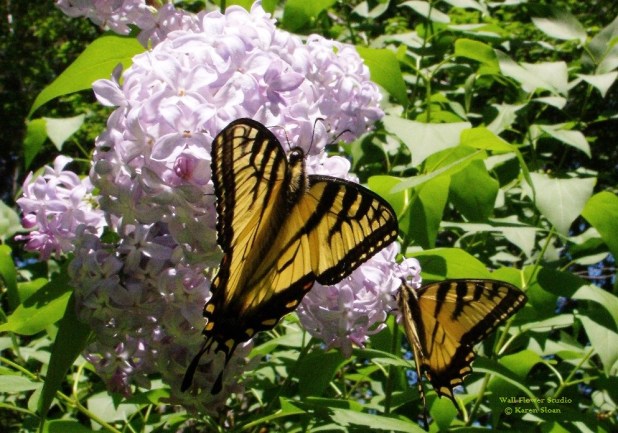
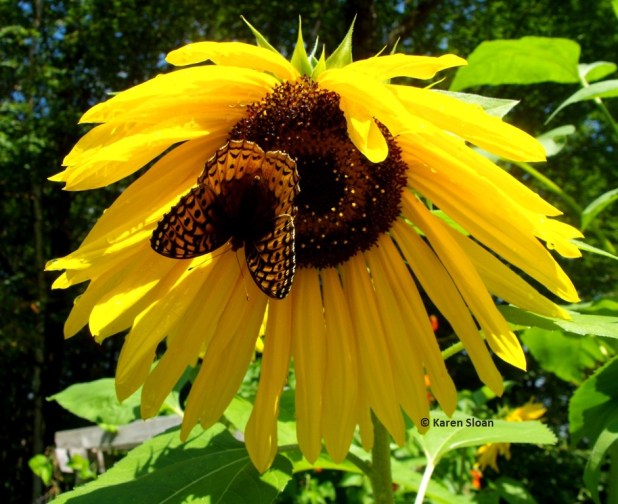
Butterflies flutter by… musings on these remarkable creatures

“Happiness is a butterfly, which when pursued, is always just beyond your grasp, but which, if you will sit down quietly, may alight upon you.” ~ Nathaniel Hawthorne

“The butterfly counts not months but moments, and has time enough.” ~ Rabindranath Tagore

“Metamorphosis has always been the greatest symbol of change for poets and artists. Imagine that you could be a caterpillar one moment and a butterfly the next.” ~ Louie Schwartzberg

And, one more quote to offer.. my personal favourite because as a child, I thought butterflies were floating flowers.

“Butterflies… flowers that fly and all but sing.” ~ Robert Frost

There have been times in my life where I’ve felt I may have been trapped in a cocoon.  Many of you may have felt like this, too. Some times this may have been self-imposed, and other times it may have been situations or circumstances beyond our control.

One thing I’ve learned to do during times like these is to call on the spirit of the butterfly.

They emerge from their original caterpillar state, through that cocoon and towards one glorious transformation! Maybe that’s why these creatures fascinate us so.

Perhaps it’s because we humans learn, grow and evolve as we go along, not unlike this marvelous creature. In any case, I feel all animals on this planet offer lessons to teach if we take the time to listen.