Vermicomposting – Let worms do the dirty work!

When it comes to vermicomposting, earthworms will do the ‘dirty’ work for you.

Most people know worms turn waste into beautiful compost outdoors, but this can be done indoors, too. It’s an easy way to compost much of your kitchen waste.

Worm castings, the black gold by-product resulting from vermicomposting, contains 5 times more nitrogen, 7 times more phosphorus, and 11 times more potassium than ordinary soil; some of the main minerals a healthy growing plant requires.

Castings are also rich in humic acids. This soil conditioner offers a perfect pH balance. It contains plant growth factors similar to seaweed. What could be better for your garden?

Here in Canada, snow covers outdoor composters and gardens for several months at a time. It might seem easier to take compostable kitchen scraps to land fill. However, for a small investment, vermicomposting can reap benefits far and above the 40 bucks initially spent, and it can be done year round, right in your kitchen!

Here’s how:

  • Purchase 2 plastic storage tote bins from the hardware store.
  • Drill ¼-inch holes in the bottom, sides and top of the box, not just for drainage but for aeration. You don’t want to smother the worms. The box should be approximately 1 square foot of surface area for each person in the household. – e.g.: A 2′ x 2′ x 2′ box can take the food waste of four people.
  • Bedding materials can include shredded newspaper, corrugated cardboard, peat moss, and partially decomposed leaves.
  • Worm boxes should be filled with bedding to provide the worms with a mixed diet, as well as a damp and aerated place to live.
  • Tear newspaper or cardboard into strips before first. Bedding material should be moistened by in water for several minutes. Squeeze out excess water before adding it to your worm box.
  • Cover food waste with a few inches of bedding so flies won’t become a problem.
  • Make sure the worm box doesn’t get too wet.  Worms will not survive and fruit flies will appear. That’s when it will smell. -> Troubleshooting worm bins
  • Red wigglers are considered the best worm to use for vermicomposting. They thrive on organic material such as yard waste and fruit and vegetable scraps.

Do feed them:

  • Coffee grounds or filters
  • Fruit and vegetable scraps
  • Small plant material
  • Tea leaves with bags

Do NOT feed them:

  • Bones
  • Milk and Dairy products
  • Fish
  • Greasy foods
  • Meat
  • Peanut butter
  • Pet/cat litter
  • Vegetable oil/salad dressing

To Harvest castings, feed one end of the box for about a week. The worms will find their way to that side to feed. Remove two-thirds of the worm castings from the opposite end and apply fresh bedding. Start burying food waste in the new bedding, and the worms will move back. The cycle continues!

Tip: Save the casting in a bag to spread on the garden, and top dress some of your indoor plants. They’ll love you for it.

Here are more great links to get you started… Have fun! : )

Forest Bathing – Mindful Meandering in Nature

Have you heard of ‘Forest Bathing’?

Forest bathing is a holistic practice focusing on our ecological health. It aligns with our fundamental need as sentient beings to interact with nature.

While studying the benefits of Biophilic design a few years ago, along with vertical gardens and terrariums, I discovered this delightful concept.

Forest bathing is an activity that can reduce anxiety, depression, and boost the immune system.

It doesn’t matter whether this is done during a ten minute break at work, or when a whole day is spent roaming through a provincial park. The simple act of observing nature offers positive mental and physical benefits to our wellbeing.

Being fortunate as I am, residing in a place surrounded by forests, my experience with this concept is not unlike that of a sponge – best served soaking up all of the goodness nature offers for free.

Originating in Japan during the 1980’s, and known there as ‘Shinrin-yoku’, the translation means either, “taking in the forest atmosphere” or “forest bathing”. Already cornerstone of preventive health care in Japanese medicine, it’s becoming known to health practitioners here in North America, too. They are beginning to see the practical use of forest bathing as a prescription for healing, helping patients by connecting them back to nature.

Akin to the practices of horticultural, animal, and art therapies, forest bathing is a sensory-based activity. In partnership with mindfulness and a green-space, it’s a tool to help us connect with the natural world. By slowing down even just for a while, we focus our attention on the beauty around us.

If only temporarily, forest bathing removes the daily distractions and stress caused by our manufactured schedules and hectic lives. Studies have shown that the aroma from certain trees in a forest has healing powers.

Forest therapy has a lasting effect on our wellbeing, lingering long after that walk in the woods.

Usually, a session entails a quiet, slow-paced walk. A group of people mindfully meander, immersed in the forest, engaging with nature, using all five of their senses.

This tempered walk is not the same as hiking. The goal is not about breaking a sweat, or hurriedly trudging on towards a specific destination.

Besides, who knows what one might come across whilst contemplating the trees and the forest? 🙂

In conclusion, I’m currently immersed in learning how to be a forest guide. I’ll be offering a forest bathing session in Haliburton Ontario this spring.

For more information, or ff you would like to sign up for this forest therapy session, (held on Saturday, May 25th, 2019), please RSVP on Facebook – event listed -> HERE (Or) at our Eventbrite listing.

Thank you!

Forest bathing links:

Questions? Please feel free to get in touch through the contact form below. Thank you!

← Back

Thank you for your response. ✨

How to best grow Basil, and some Folklore, too

Basil – Arguably one of the most popular kitchen herbs today, it adds just the right flavour to so many recipes. But, did you know there is folklore surrounding this tasty plant?!
Inspired by #FolkloreThursday on Twitter for some time now, I began researching my favourite plants and flowers to learn their history, and what connections if any, they may have to ancient lore, superstitions, or stories.

In parts of Italy to this day, Basil is considered an herb that inspires love. Its scent is thought to bring about sympathy, and Medieval Italian maidens gave their chosen love a sprig of Basil to ensure their love would be returned in full.

With antibacterial properties, basil is considered to be good insect repellent. Along those lines, it’s good for hornets and wasp stings too, according to Culpeper, “Being applied to the place bitten by the venomous beast, or stung by a wasp or hornet, it speedily draws the poison to it“.
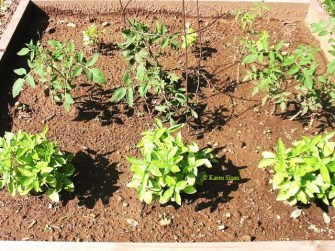
To carry a sprig of Basil in your purse or wallet is supposed to be a way to draw money and abundance to you and your bank account.  <-  I’ve tried with limited success. 😉

In dispute of what I’ve shared above, the Dierbach’s Flora Mythologica der Griechen und Römer, claims Basil represents poverty. In addition, the approved modern English ‘Dictionary of Flowers,’ states that offering Basil is a way to show hate to one’s enemy.

Who are we supposed to believe? Better not chance it, I’ve just removed the sprig of Basil from my wallet. Perhaps that’s why there was limited success.

According to ‘The Expert Gardener’ (1640), a work “faithfully collected from Dutch and French authors”, and a whole chapter devoted to the times and seasons which one should “sow and replant all manner of seeds”, this book offers special reference to the phases of the Moon. Specific to Basil and when to sow, reads: “must be sowne in March, when the Moone is old.”

As it’s still February, we’re not quite there. Another month to go before sowing those seeds. But when you do, here is some practical information on how best to grow it.

Basil will reach a height of 24″and spreads from 12-15″
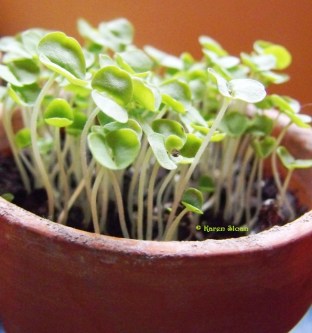
Germination takes 7-10 days, and they should be sown at a shallow depth of 1/8″

Planting Season, other than the folklore above, I suggest outdoors in containers, 1-2 weeks after the last Spring frost has gone. Basil requires full sun for best success, and well-drained soil with plenty of organic matter.

In any case, with more than 150 varieties of Basil available, my personal favorites include Lemon Basil (Ocimum citrodorium), Purple Basil, less common than its traditional green counterpart, but with an uplifting, punchy flavour and a rich, show stopping colour, and last but not least, the ever popular Italian Large Leaf Basil, that some call Genovese.

All three are perfect for pesto, pasta sauces, and herbal vinegar.

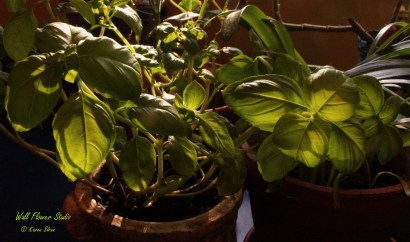
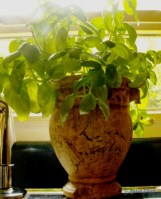
Basil is best used fresh, picked from containers close to your kitchen! Mine are by our dining room door where we have sun all day long.

Thankfully, Basil has very few pests, and you can also use it as a companion plant to repel mites and tomato worms. As the saying goes, ‘Tomatoes loves Basil’.

Basil loves its tips pinched, which will encourage fuller plants, delay flowers, and keep it from going to seed.

I suggest letting one plant go to seed so that you can save them to grow again next year, or share with friends.

Personally, I grow Basil indoors on our sunny windowsill all year long. The seeds can be planted anytime!

Pest Recipe – Wall Flower Studio – Feel free to print and share.

Enjoy!

The Subtle Splendour of Snowdrops in Springtime

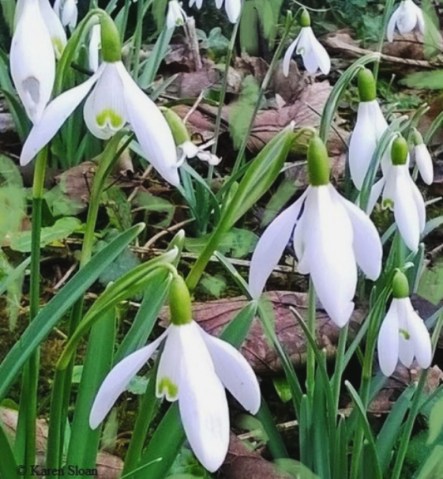
 Admired for their subtle splendour, Snowdrops (Galanthus nivalis), are small flowering bulbs originating from Eastern Europe and Russia. Nowadays, this ornamental plant is naturalized around the world.

A precursor to spring, the snowdrop is one of the earliest flowers blooming in our gardens. A welcome sight to many after a long, cold winter, including me.

As an early flowering plant, snowdrops are an important early spring food source for pollinators.

According to lore, snowdrops were once held sacred as flowers representing virginity during medieval times, which may account for their naturalized state near convents and monastic buildings.

“A flow’r that first in this sweet garden smiled,
To virgins sacred, and the Snowdrop styled.”Thomas Tickell

Peasants in some parts of England considered it unlucky to take a sprig into a house. Single flowers were harbingers of impending death, so I wonder if a bouquet would have been a safer bet?! In any case, this flower was viewed as a death-token by peasants who looked at it like it was a shrouded corpse. I suppose there’s no accounting for taste!

However, knowing that the whole plant is toxic, bulb included, perhaps some poor medieval soul took a bulb inside, ate it thinking it was a shallot, and promptly met their maker. My own speculation, but perhaps that’s how folklore surrounding all sorts of morbidity begins . In this case and others, we’ll not likely ever know!

In any case, right now, snowdrops are blooming in many parts of Europe and the British Isles. I won’t likely see them popping up in my garden for another six weeks or so, but until then, I’ll live vicariously, viewing photos on social media from people across the pond or in the lower U.S. states, where spring is ready to roll!

– Anticipation seems to be the mainstay of many a gardener!

Itchy Green Fingers? Lets Start Sowing #Seeds

Gardeners can rejoice because it’s time to get the jump on spring! Time to start sowing seeds indoors.

If you have itchy green fingers this time of year like I do, here are some suggestions on how to get growing!

In in a pinch, (pun intended), and need to find quick and inexpensive labels? Clothes pins are the way to go, (popsicle sticks work equally well), and it’s simple to write the variety of seed you’re growing on them and then clip them to the pot.

When the time comes to planting the seedlings in the garden, the clothespin can be switched to a bamboo stake, or a popsicle stick can be stuck right in the ground.

These labels can be decorated, too! That’s a great way to involve the kids, and we all know Pinterest offers an abundance of creative ideas to do just that. 🙂

Egg shells and egg cartons work particularly well. The egg is nature’s packaging, and the carton is a ready made holder that conveniently comes with the eggs!

After that Sunday breakfast, keep the shells and pot them up with your seeds.

Eggshells will do more than just keep slugs away from a Hosta.  They’re an organic way to provide calcium to the soil. The seedlings benefit, and any worms in the garden will be quite happy to make compost out of them.

The whole enchilada can be planted in the ground, and the best thing of all is that their tender roots won’t be disturbed once it’s time for them to be planted outside.

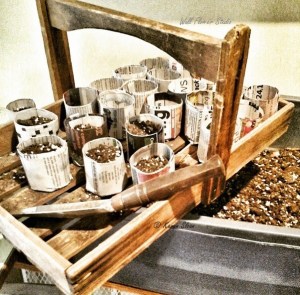
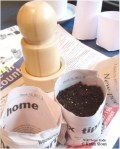
Containers from newspapers work well, too. The best 20 bucks I ever spent was on a pot maker purchase! Every year it repays me because it’s easy to make these recycled containers, which also keeps some paper out of the landfill site. Newspaper will break down in the garden, so they too can be planted directly in to the garden.

No muss, no fuss.

My kind of gardening!