Four-leaf clovers – More than a lucky Irish symbol

You don’t have to be Irish to know a four-leaf clover is a universal symbol of good luck. This accepted belief is as old as the hills.

A description from 1869 states “four-leaf clovers were gathered at night-time during the full moon by sorceresses, who mixed it with other ingredients, while young girls in search of a token of perfect happiness made quest of the plant by day”

Druids held four-leaf clovers in high esteem. They too considered them a sign of good luck.  As much as I love to read about, and devour any information on these mystical figures, I do take some of it with a grain of salt.

The sad reality is, we just don’t know much about Druids. Except for information written by the likes of Julius Caesar, Tacitus, and Strabo, who as Roman conquerors, and Druids being their enemy, any account from them is likely to be biased.

There are however, many Irish myths and legends pertaining to Druids which may hold historic value and even factual events. But I digress…

Irish folklore tells us finding a clover with four leaves will bring you good luck, however finding a stem with five leaves or more will not bring you more luck.

I’d have to disagree with that. The odds would have to be pretty high for someone to find one, so I’d consider it even more fortunate, indeed!

Each of the four leaves has its own representation, though this varies depending on who you speak with about it. Generally, the most popular meanings are:

  • Faith
  • Hope
  • Love
  • Luck

By the same token, a clover with three leaves has symbolism, too. According to Pliny, it’s connected to the Holy Trinity. In addition, clover was used to make a salve against snake bites, since snakes represented Original Sin, and encouraged by that dastardly serpent in the Garden of Eden. Here, each leaf represents a good deed. In this case:

  • Faith
  • Hope
  • Charity

The most widely cultivated clovers are white clover, Trifolium repens, and red clover, Trifolium pratense.

Clover shoots up easily, even after repeated mowing. It produces nutritious crop for livestock and fixes nitrogen in the soil, which reduces the need for synthetic fertilizer. It grows in all kinds of climates, and it’s a great addition to your compost bin.

Last but not least, it’s one of the earliest plants to produce flowers, making it an important source of nectar for our pollinators, especially bees.

Of interest to floral historians, the Four-Leaf Clover in floral language means – ‘Be Mine’.

Several years ago, I was lucky enough to find a four-leaf clover. I pressed it between the pages of a book, and since then its sat, on one of the bookshelves in my house. Now that I’m writing this post, I’ll have to search for it.

I figure it doesn’t matter if you find the same one twice! When it turns up, it will still be a lucky find.

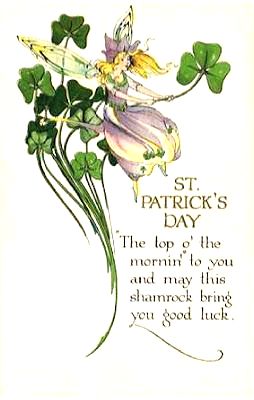
Top o’ the mornin’ to ya. Make sure to wear something green!

Happy St. Patrick’s Day!


Sources:

  • Rutherford, Ward (1978). The Druids and their Heritage. London: Gordon & Cremonesi.
  • Celtic Studies Resources: Did the Celts or Druids Perform Human Sacrifice?
  • Pliny the Elder. Naturalis Historia. c.78 CE.
  • Tacitus. Annales. Second century CE.
  • Masters MT. 1869. Vegetable Teratology, An Account of the Principal Deviations from the Usual Construction of Plants. Robert Hardwicke Publisher, London, P 356.
  • Mark Kinver, Science and environment reporter, BBC News – Science/Environment – Bumbles make beeline for gardens, study suggests
  • The bouquet – A Poetic Treasury of Flowers, Their Classics and Vocabulary, (pg. 13) by Walser, G. H. (George Henry), 1834-1910
  • Cyclopedia of practical floriculture by Turner, Cordelia Harris – Publication date 1884
  • The images are royalty-free. Use and share as you like.
Forest Bathing – Mindful Meandering in Nature

Have you heard of ‘Forest Bathing’?

Forest bathing is a holistic practice focusing on our ecological health. It aligns with our fundamental need as sentient beings to interact with nature.

While studying the benefits of Biophilic design a few years ago, along with vertical gardens and terrariums, I discovered this delightful concept.

Forest bathing is an activity that can reduce anxiety, depression, and boost the immune system.

It doesn’t matter whether this is done during a ten minute break at work, or when a whole day is spent roaming through a provincial park. The simple act of observing nature offers positive mental and physical benefits to our wellbeing.

Being fortunate as I am, residing in a place surrounded by forests, my experience with this concept is not unlike that of a sponge – best served soaking up all of the goodness nature offers for free.

Originating in Japan during the 1980’s, and known there as ‘Shinrin-yoku’, the translation means either, “taking in the forest atmosphere” or “forest bathing”. Already cornerstone of preventive health care in Japanese medicine, it’s becoming known to health practitioners here in North America, too. They are beginning to see the practical use of forest bathing as a prescription for healing, helping patients by connecting them back to nature.

Akin to the practices of horticultural, animal, and art therapies, forest bathing is a sensory-based activity. In partnership with mindfulness and a green-space, it’s a tool to help us connect with the natural world. By slowing down even just for a while, we focus our attention on the beauty around us.

If only temporarily, forest bathing removes the daily distractions and stress caused by our manufactured schedules and hectic lives. Studies have shown that the aroma from certain trees in a forest has healing powers.

Forest therapy has a lasting effect on our wellbeing, lingering long after that walk in the woods.

Usually, a session entails a quiet, slow-paced walk. A group of people mindfully meander, immersed in the forest, engaging with nature, using all five of their senses.

This tempered walk is not the same as hiking. The goal is not about breaking a sweat, or hurriedly trudging on towards a specific destination.

Besides, who knows what one might come across whilst contemplating the trees and the forest? 🙂

In conclusion, I’m currently immersed in learning how to be a forest guide. I’ll be offering a forest bathing session in Haliburton Ontario this spring.

For more information, or ff you would like to sign up for this forest therapy session, (held on Saturday, May 25th, 2019), please RSVP on Facebook – event listed -> HERE (Or) at our Eventbrite listing.

Thank you!

Forest bathing links:

Questions? Please feel free to get in touch through the contact form below. Thank you!

← Back

Thank you for your response. ✨

DIY Seed Balls – Throw and Grow the Love in Your Garden

After reading a LOT of information about genetically modified seeds, and in turn learning about ‘guerrilla gardening’, I was further led to the discovery of ‘seed balls.

Seed balls are sustainable, ecofriendly tools, initially created for ecological urban renewal. On a less serious note, they’re just a whole lot of fun!

Seed balls solve many of the problems loose seeds face before they have the chance to grow.

Wind can blow seeds away, birds or rodents might eat them, the sun can bake out their vitality, and excessive rain can carry them off. Seed balls protect them from all of that.

A seed ball is a little ecosystem that protects the seeds inside before they sprout. Essentially, it’s a ball of soil, clay and seeds, that when thrown, dropped, or placed in the spot where you’d like the seeds to grow, (and after it receives some moisture or rain), the seed ball acts like a micro-garden that slowly starts to break down as the seeds inside begin to emerge.

The seeds are then nurtured in that same pile of clay and nourishing soil. and because of this, seed germination from seed balls is very high!

So enamoured with the concept, I immediately set out to make some. In fact, over the last decade, I’ve made thousands, distributing them across North America, in packages of a dozen to individuals, and bulk quantities to be passed out at all kinds of events.

I also make them just for me.

By customizing the variety of plants every year, depending on what seeds I saved, I make a batch to throw on the steep hill beyond our back yard. It has beautified an underused space with flowers that encourage pollinators!

Anyone can make seedballs! Here’s how:

Before you begin, and I learned this the hard way so you don’t have to, this can be a messy project, especially if kids are involved, so to save time and aggravation, don’t wear your best clothes, and remove your rings! – Now for the recipe!

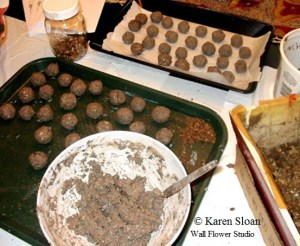
  1. Mix two parts soil, two parts dry powdered clay, and a whole lot of seeds.
  2. The varieties here include a range of drought tolerant native species harvested from my own garden. However, you can use any flower seed, herbs, fruit or veggie.
  3. Next step is to add water.  Not too much, or too quickly, but enough to make the mixture damp. Stir it in slowly. If the mix is too dry, it won’t hold together so add a bit more. If the soil and clay become overly wet, the seeds will sprout before your finished seedballs get a chance to dry, which means you can’t store them to use at a later date. If the clump holds together, but won’t ooze water if you squeeze it, then that’s the perfect consistency.
  4. Then, roll the small clump in your hands into the size of a meatball and place them on trays to dry. If you’re fortunate enough to have a grow light stand, put them under the lights overnight. They’ll be almost completely dry the next day. If not, it will take a couple of days. Put them next to a heat register if you have room.
  5. Just a note to tie in with step 1 – If you’re using sunflower seeds which are large in size, I’d suggest rolling the balls first, then manually pushing a few seeds inside after.

Once they’re completely dry, they can be packaged and given as gifts to friends and family! This is a great project for kids, too.

If you’re really feeling motivated and want to make more, how about getting creative? Use a candy/soap mold to make different shape seed balls!

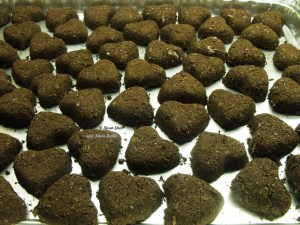
I picked up a heart shaped chocolate mold at a local thrift shop and have used it for years to make the heart shaped seed balls. They’ve been a favourite choice for wedding favours and for non-profits to hand out to volunteers at events.

Just to add, they’re really popular this time of year as a Valentine’s Day gift. Enjoy, and grow some love!


The Red Fox – A fabulous forest-lurker, neighbour, and totem animal.

Fox hunting for voles and mice.

Our backyard is a special place because of the abundance of wildlife in our neck of the woods. I am extremely fortunate to witness a diversity of animal/bird species who wander through on a regular basis.

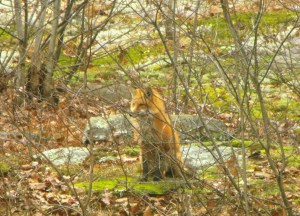
One of my favourite visitors is the lovely Red Fox, (Vulpes vulpes).

These solitary hunters are intelligent, opportunistic omnivores, about the size of a small to mid-sized dog, and they rather remind me of a cat because of the way they play with their food, tossing the soon to be meal, (voles & other rodents) in the air with abandon, just before ending this celebration to seriously chow down on their catch.

Like many of us humans, the red fox prefers a diverse habitat! For them, that includes farm fields, forests, the edge of thickets, and even urban settings, where like the racoon they also thrive. From my experience in a rural setting, they hunt in and out of these habitats, which describes our backyard, and is likely why I see them so often.

The adult red fox has a year-round coat of red that is absolutely striking to see in the winter, as you can see it here in contrast with snow.

Yes, there are some people who find satisfaction by wearing these beauties on their own backs. I’m not one of them and prefer to see the animal alive and well, in its own coat. Luckily, I don’t yet carry tomatoes & won’t pelt, (pardon the pun) fur wearing folk. However, I will offer an unequivical icy glare and judge you in a negative light. But, I digress…

Fox with mange.

Foxes are shy animals. They’re mainly nocturnal, but occasionally one will see these non-aggressive creatures during the day. If you see a fox during the day, it doesn’t mean that they are diseased with rabies or mange, though that can be the case. It more likely it means food may be more available for them during daylight hours in their respective environment.

If you’re interested in animal lore and totem animals like I am, there is a phenomenal amount of information available, making the fox an interesting subject to read about in many folkloric and mythic tales.

Consider the term “to outfox“, which means “to beat in a competition of wits”, similarly to “outguess”, “outsmart”, and “outwit”.  If you consider Aesop’s Fables from classical antiquity to Beatrix Potter‘s anthropomorpic stories, there are numerous stories involving a fox in popular culture throughout history.

Fox focus

Within the spiritual realm, they’re considered figures of cunning or trickery, or as a familiar animal possessed of magic powers and transformation.

As for having the lovely fox as a totem animal, it suits me well.

According to many who’ve interpreted the fox as a totem animal messanger, a fox will communicate its presence in order to offer the advice that you should think outside of the box. They also show us how to focus on our goals, and to use our creativity in our approach to current circumstances.

My feeling is that the fox encourages us to be aware of our own habits, (good or bad), adapt to our environment using all of our resources, and that we should refrain from certain distractions that may lead us off course when we want to realize a goal.

In any case, the Red Fox is a wonderful creature and participant in the planet’s food chain. They’re an animal that deserves our respect, and it is a real gift to see them in nature.


Home-Grown and Wildcrafted Smudge Sticks: Plant List and Recipes

Dana's avatarThe Druid's Garden

Basket of newly made smudge sticks Basket of newly made smudge sticks

Creating homemade smudge sticks with local ingredients is a wonderful activity to do this time of year.  As the plants die back, you can harvest whatever you aren’t using for other purposes and create a number of beautiful smudges that can be used for many different purposes: clearing, honoring spirits, protection, setting intentions, letting go, bringing in, preparing for ritual or mediation, and much more.

A few years ago, I wrote an initial post on homemade smudge sticks using local ingredients–this has become my most popular post on my blog.  Given that, I wanted to offer a follow-up post with some additional information and share a few smudge stick recipes for specific purposes. For initial instructions on how to make your sticks, please see my first post.  This post expands the plant list that you can use to make smudges and also offers…

View original post 2,497 more words