How to best grow Basil, and some Folklore, too

Basil – Arguably one of the most popular kitchen herbs today, it adds just the right flavour to so many recipes. But, did you know there is folklore surrounding this tasty plant?!

Inspired by #FolkloreThursday on Twitter for some time now, I began researching my favourite plants and flowers to learn their history, and what connections if any, they may have to ancient lore, superstitions, or stories.

In parts of Italy to this day, Basil is considered an herb that inspires love. Its scent is thought to bring about sympathy, and Medieval Italian maidens gave their chosen love a sprig of Basil to ensure their love would be returned in full.
With antibacterial properties, basil is considered to be good insect repellent. Along those lines, it’s good for hornets and wasp stings too, according to Culpeper, “Being applied to the place bitten by the venomous beast, or stung by a wasp or hornet, it speedily draws the poison to it“.

To carry a sprig of Basil in your purse or wallet is supposed to be a way to draw money and abundance to you and your bank account.  <-  I’ve tried with limited success. 😉

In dispute of what I’ve shared above, the Dierbach’s Flora Mythologica der Griechen und Römer, claims Basil represents poverty. In addition, the approved modern English ‘Dictionary of Flowers,’ states that offering Basil is a way to show hate to one’s enemy.

Who are we supposed to believe? Better not chance it, I’ve just removed the sprig of Basil from my wallet. Perhaps that’s why there was limited success.
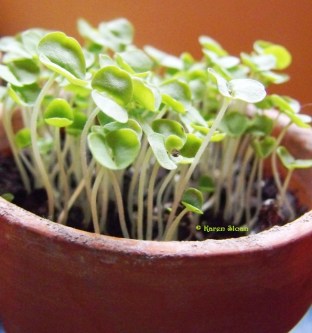
According to ‘The Expert Gardener’ (1640), a work “faithfully collected from Dutch and French authors”, and a whole chapter devoted to the times and seasons which one should “sow and replant all manner of seeds”, this book offers special reference to the phases of the Moon. Specific to Basil and when to sow, reads: “must be sowne in March, when the Moone is old.”

As it’s still February, we’re not quite there. Another month to go before sowing those seeds. But when you do, here is some practical information on how best to grow it.

Basil will reach a height of 24″and spreads from 12-15″
Germination takes 7-10 days, and they should be sown at a shallow depth of 1/8″

Planting Season, other than the folklore above, I suggest outdoors in containers, 1-2 weeks after the last Spring frost has gone. Basil requires full sun for best success, and well-drained soil with plenty of organic matter.

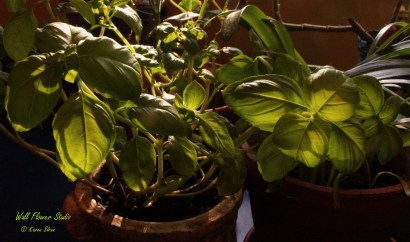
In any case, with more than 150 varieties of Basil available, my personal favorites include Lemon Basil (Ocimum citrodorium), Purple Basil, less common than its traditional green counterpart, but with an uplifting, punchy flavour and a rich, show stopping colour, and last but not least, the ever popular Italian Large Leaf Basil, that some call Genovese.

All three are perfect for pesto, pasta sauces, and herbal vinegar.

Basil is best used fresh, picked from containers close to your kitchen! Mine are by our dining room door where we have sun all day long.
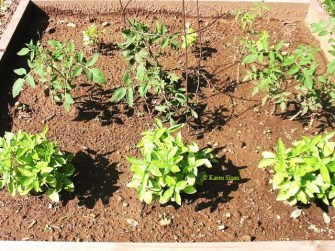
Thankfully, Basil has very few pests, and you can also use it as a companion plant to repel mites and tomato worms. As the saying goes, ‘Tomatoes loves Basil’.

Basil loves its tips pinched, which will encourage fuller plants, delay flowers, and keep it from going to seed.

I suggest letting one plant go to seed so that you can save them to grow again next year, or share with friends.

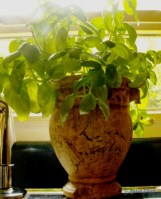
Personally, I grow Basil indoors on our sunny windowsill all year long. The seeds can be planted anytime!

Pest Recipe – Wall Flower Studio – Feel free to print and share.

Enjoy!
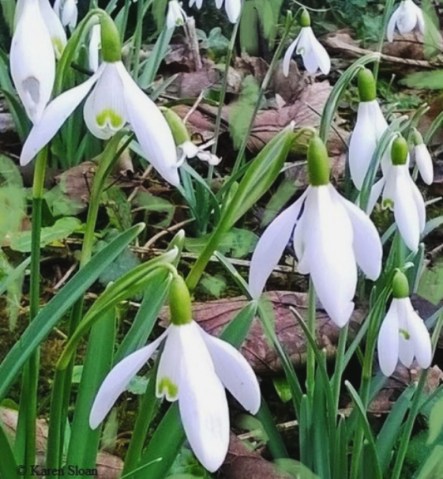
The Subtle Splendour of Snowdrops in Springtime

 Admired for their subtle splendour, Snowdrops (Galanthus nivalis), are small flowering bulbs originating from Eastern Europe and Russia. Nowadays, this ornamental plant is naturalized around the world.

A precursor to spring, the snowdrop is one of the earliest flowers blooming in our gardens. A welcome sight to many after a long, cold winter, including me.

As an early flowering plant, snowdrops are an important early spring food source for pollinators.

According to lore, snowdrops were once held sacred as flowers representing virginity during medieval times, which may account for their naturalized state near convents and monastic buildings.

“A flow’r that first in this sweet garden smiled,
To virgins sacred, and the Snowdrop styled.”Thomas Tickell

Peasants in some parts of England considered it unlucky to take a sprig into a house. Single flowers were harbingers of impending death, so I wonder if a bouquet would have been a safer bet?! In any case, this flower was viewed as a death-token by peasants who looked at it like it was a shrouded corpse. I suppose there’s no accounting for taste!

However, knowing that the whole plant is toxic, bulb included, perhaps some poor medieval soul took a bulb inside, ate it thinking it was a shallot, and promptly met their maker. My own speculation, but perhaps that’s how folklore surrounding all sorts of morbidity begins . In this case and others, we’ll not likely ever know!

In any case, right now, snowdrops are blooming in many parts of Europe and the British Isles. I won’t likely see them popping up in my garden for another six weeks or so, but until then, I’ll live vicariously, viewing photos on social media from people across the pond or in the lower U.S. states, where spring is ready to roll!

– Anticipation seems to be the mainstay of many a gardener!

The Red Fox – A fabulous forest-lurker, neighbour, and totem animal.

Fox hunting for voles and mice.

Our backyard is a special place because of the abundance of wildlife in our neck of the woods. I am extremely fortunate to witness a diversity of animal/bird species who wander through on a regular basis.

One of my favourite visitors is the lovely Red Fox, (Vulpes vulpes).

These solitary hunters are intelligent, opportunistic omnivores, about the size of a small to mid-sized dog, and they rather remind me of a cat because of the way they play with their food, tossing the soon to be meal, (voles & other rodents) in the air with abandon, just before ending this celebration to seriously chow down on their catch.

Like many of us humans, the red fox prefers a diverse habitat! For them, that includes farm fields, forests, the edge of thickets, and even urban settings, where like the racoon they also thrive. From my experience in a rural setting, they hunt in and out of these habitats, which describes our backyard, and is likely why I see them so often.

The adult red fox has a year-round coat of red that is absolutely striking to see in the winter, as you can see it here in contrast with snow.

Yes, there are some people who find satisfaction by wearing these beauties on their own backs. I’m not one of them and prefer to see the animal alive and well, in its own coat. Luckily, I don’t yet carry tomatoes & won’t pelt, (pardon the pun) fur wearing folk. However, I will offer an unequivical icy glare and judge you in a negative light. But, I digress…

Fox with mange.

Foxes are shy animals. They’re mainly nocturnal, but occasionally one will see these non-aggressive creatures during the day. If you see a fox during the day, it doesn’t mean that they are diseased with rabies or mange, though that can be the case. It more likely it means food may be more available for them during daylight hours in their respective environment.

If you’re interested in animal lore and totem animals like I am, there is a phenomenal amount of information available, making the fox an interesting subject to read about in many folkloric and mythic tales.

Consider the term “to outfox“, which means “to beat in a competition of wits”, similarly to “outguess”, “outsmart”, and “outwit”.  If you consider Aesop’s Fables from classical antiquity to Beatrix Potter‘s anthropomorpic stories, there are numerous stories involving a fox in popular culture throughout history.

Fox focus

Within the spiritual realm, they’re considered figures of cunning or trickery, or as a familiar animal possessed of magic powers and transformation.

As for having the lovely fox as a totem animal, it suits me well.

According to many who’ve interpreted the fox as a totem animal messanger, a fox will communicate its presence in order to offer the advice that you should think outside of the box. They also show us how to focus on our goals, and to use our creativity in our approach to current circumstances.

My feeling is that the fox encourages us to be aware of our own habits, (good or bad), adapt to our environment using all of our resources, and that we should refrain from certain distractions that may lead us off course when we want to realize a goal.

In any case, the Red Fox is a wonderful creature and participant in the planet’s food chain. They’re an animal that deserves our respect, and it is a real gift to see them in nature.


Forage for Borage – A historic and useful herb for any garden

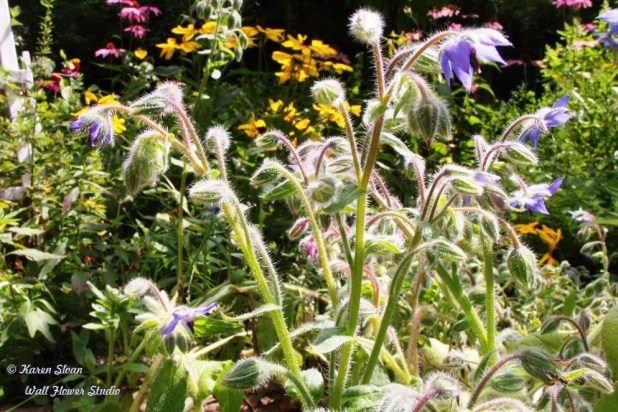
Borage flowers – A true blue addition to any garden!

This herb with its star-shaped flowers is not only beautiful, but extremely useful!

I’ve always felt this plant was underrated in our gardens, unlike in the past where its qualities were highly valued.

Admiring them as one would any species with a historical pedigree, this heirloom has been cultivated since (at least) the 1400s, and the folklore they encompass states just how much borage was valued.

It was said to bring courage to one’s heart. “Borage for courage” as the saying goes. Ancient Celtic people believed borage offered courage in the face of enemies on the battle field. How extraordinary!

In our modern times the quote should be renamed “Forage for Borage” 😉  As a courageous companion plant, it’s known to repel hornworms on tomatoes, offering this plant a serious if not fashionable comeback.

Borage may be considered an annual herb where I live, but it self seeds easily and appreciates any extra warmth offered by the raised beds in our yard. They’ve settled in quite happily!

The dainty flowers are edible, offering a slight cucumber-like flavour. Use them in soups, salads, sandwiches, or as a substitute for spinach (stuffed into traditional pasta), or as a pretty garnish on the plate. A friend of mine uses them to flavour her pickles, while another makes teas and assorted iced drinks with them. In addition there’s a recipe for a simple syrup at the end of this post.

Thankfully Borage is not a fussy plant and grows well in most soils. I’m happy to report that deer avoid Borage like the plague, likely due to its fuzzy leaves. A real plus in many a gardener’s mind!
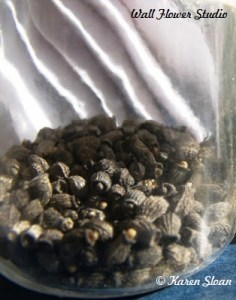
If you like to save and share, Borage seeds are easily harvested, or leave them to self sow.
Every year you can look forward to them gracing the garden once again.

Those showy little blue star-shaped flowers attract bees, butterflies, and all sorts of good pollinators. They’re a wonderful addition to anyone’s garden!

Note:

  1. When planting Borage seeds, the best time to do this is in spring, after any remaining chance of frost. Soak the seeds first in wet paper towel overnight, and then sow them directly into the garden, but not too deep, as half an inch will suffice.
  2. Borage will grow to a height of 2- 3 feet.
  3. The oil from Borage seeds is highly valued and plants are now commercially cultivated for skin care products and other items. It’s one of my favourite go-to ingredients for use in my own products.
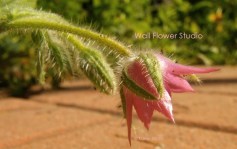
  4. If you see some of your flowers are pink, then there is likely a deficiency in your soil. Below is a photo from a couple of years ago. I’ve since discovered this is a common site if Borage is growing in dry, gravelly soil. To fix this, simply add some triple-mix or compost. The pink is actually quite pretty, and Borage may even offer white flowers from time to time.

Recipe: Borage Simple Syrup

This simple syrup offers up a light cucumber flavour.

1 cup water
2 cups sugar
1/2 cup borage flowers

– Bring the sugar and water to simmer, until all the sugar has dissolved.
– Add the flowers, simmer for 2 -3 minutes and remove from heat
– Let this steep for at least 2 hours before straining.
– Keep this in the refrigerator and use within one month.
– Makes about 1 & 1/4 cups

It’s the perfect addition to a summer cocktail.. Enjoy!

Happy Gardening! 🙂


Along with beauty and scent, Hyacinth flowers offer us myth and folklore, too!

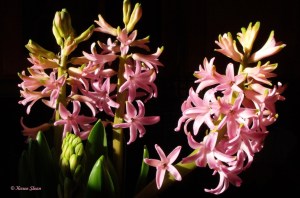
Several weeks ago we hosted a wonderful family gathering at our home. Because of this, we were the lucky recipients of beautifully potted, forced hyacinths.

A Hyacinth, aka Hyacinthus, are bulbous, perennial plants, native to the eastern Mediterranean from the south of Turkey to northern Israel.

Here in Canada, we plant these hardy bulbs in the fall.  Come springtime, they grow to a height of 6-8 inches, appearing in our gardens after the snow and (hopefully) any frost has gone.

The Hyacinth was so popular in the 18th century that more than 2,000 cultivars were grown in the Netherlands, its chief commercial producer.

I enjoyed the heady aroma of these spectacular spring flowers very much over the course of the following week. When heading upstairs to our kitchen where the flowers were on display, I could smell them before seeing them. Admittedly, I could get used to that!

After such a long winter, (hopefully behind us now, but with today’s weather, that’s questionable), it was a pure feeling of joy to experience the sight of those blooms and their exquisite perfume.

‘The Death of Hyacinth’ by Giovanni Battista Tiepolo. – Museo Thyssen-Bornemisza, Madrid. Public Domain

These lovely, highly scented Hyacinths earned their name to honour a youth, accidentally killed by his friend and lover, the Greek god Apollo.

Homer wrote that the flowers appeared when the drops of blood from this fallen fellow met the ground.

Many floral enthusiasts like me are curious about botanical symbolism and the history behind flower names.

Any legendary correlations, little known details, quips, lore and tales about the natural world, linking all of it together, are usually a delight to discover!

I suspect any plant one could name, be it flower or tree, has a yarn spinning behind it!

With relation to the natural world, classical literature linked flowers to the gods via epic poems and tales that Homer, Ovid and others have spun, explaining beauty and the creation of so many botanical species.

Others fairy tales include life lessons that even today point out human frailties. Our contemporary society can still learn from these relatable plots as we still manage to trip over our own egos from time to time, not unlike the characters from many a fable.

With that in mind, it’s no wonder to this day we still offer floral tributes honouring people in our lives, marking every event from birth to death, and everything in between, or just because!

As you can see, cats aren’t immune to botanical beauties either. Even my cat Luna likes to stop and smell the flowers!

Have a good weekend, and Happy Gardening!