Everyone can save seeds!
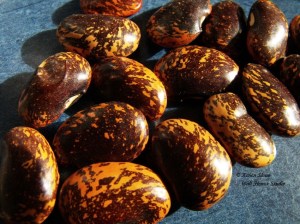 Beginners and experienced gardeners can easily learn how.
I’d like to offer a few reasons on why we should save our seeds.
1) Saving seeds appeals to my motto of “waste not want not”.
I hate to see anything good go unused, and the economical reasons alone, especially in today’s financial climate, makes a ton of sense.
Seed savers knows that by gathering up seeds and storing them carefully away for next year’s garden is preservation for next year’s crop, and less money to fork out.
2) Personal selection.
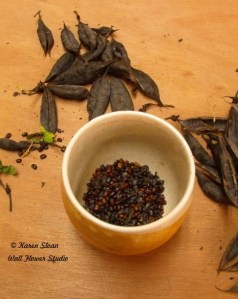 I like the thought of developing my own vigorous strains over several seasons of selective seed saving. By saving seeds from the plants with the qualities you most prize, you will soon have varieties that are ideally adapted to your garden and growing conditions.
3) Maintain biodiversity.
This is likely the most important reason.
Fewer and fewer old varieties of food crops are available, so seed saving keeps the vegetable world’s food choices diversified.
Today many of the world’s food plants are disappearing, including vegetables, grains and fruit varieties.
Approx. 70 % of the world’s major food plants have already been lost. This is because modern agriculture practices require high yield, uniform plants, so the genetic base of the world’s food plants has been greatly reduced. This has left the world dependent on a few, closely related varieties of each crop.
4) Historical value.
 Many plant varieties we save or trade are living links to the past.
Seed saving is a way to link with our ancestors. As gardeners, this is a responsibility and opportunity to pass these wonderful heirlooms to future generations.
5) Sustainability.
Many big companies sell varieties that are tasteless, but travel well. That’s not a good enough reason for me. Self reliance is very satisfying. It is our right to save seeds and make sure that there is enough variety on the planet which makes for biodiversity. It’s the cycle of life.
 The thing is, we don’t need gigantic corporate conglomerates holding all the cards, or whittling down our choice of food or flowers.
These big companies, (I don’t have to mention names here), make most of their money, (their sole goal), selling toxic chemicals to spray produce with, on food that we ingest.
I’ll never be convinced this aim of theirs benefits us or any other form of life on earth, including the smallest microbes in soil.
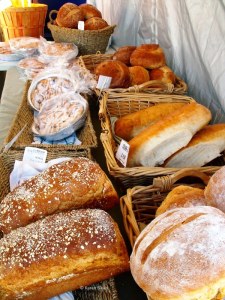 Consider shopping locally if you can! Farmers’ markets & local festivals are a great place to start. Many locally based businesses carry organically sourced goods from small producers in their region, and of course almost anything can be acquired online.
For more information visit:
Seeds Of Diversity
Canada’s Heritage Seed Program – A non-profit group of gardeners who save seeds from rare and unusual garden plants for the purpose of preserving varieties – Purchase the manual – “How to Save Seeds” from their website!
Navdanya
Vandana Shiva on Seed Saving – “The desire to save seeds comes from an ethical urge to defend life’s evolution” says Vandana Shiva, activist, author and scholar.
150,000 farmers in India have committed suicide in areas where seed has been destroyed…where they have to buy the seed every year from Monsanto at a very high cost.
Saving seeds is crucial now for our farmers, for the plant varieties and species that will otherwise be extinct, for the health of the land and ourselves.
Seed Savers (U.S.A.)
“Since 1975, we have grown, saved, and shared heirloom seeds and led a movement to protect biodiversity and preserve heirloom varieties. At the heart of our organization is a seed bank that houses a collection of 20,000+ rare, open-pollinated varieties.”
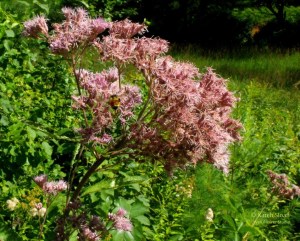 Joe Pye Weed, aka Eupatorium maculatum, (or in some circles, Eutrochium), is a big favourite with bees, butterflies, and me!