 As humans, we’ve been creating symbolism with flowers and plants since time immemorial.
Flowers can convey messages that we can’t always speak. They represent every sentiment one could think of, and as a floral designer, I’ve always been fascinated by this partnership between humans and the language of flowers.
With Remembrance Day upon us, I began to consider our link to the Poppy.
It ended up that I dug quite a bit further back in history than World War I & II.
I discovered an enormous amount of interesting information about the evolution of the poppy, and how it’s played a part in tandem with humanity over the centuries.
Probably the best known Poppy is the Papaver somniferum, which is the opium Poppy. It was domesticated by indigenous people from Western and Central Europe between 6000 and 3500 BC. It’s believed that the use of opium may have originated with the ancient Sumerian people.
 Papaver somniferum L. is one of the oldest cultivated plants with the hypothesis that this particular poppy is derived from the species Papaver setigerum, which grows wild along the Mediterranean region.
Western Asia is also considered the center of poppy’s origin. The oldest documented traces of poppies in Europe come from the Neolithic period, as evidenced by poppy seeds found in the Alps.
The ancient Egyptians of the eighteenth dynasty created containers made in the shape of poppies. These Juglets as they’re called, have been found with trace amounts of opium still inside. The flower also appears on jewelry and other art objects from that era, and opium seemed to offer a ritual significance as its use was generally restricted to priests.
Poppies and opium then made their way around the known world via the Silk Road. In Turkey, the poppy has been a traditional plant since 3,000 BC, and the city Afyon in central Anatolia (Turkey) was named after them. “Afyon” in Turkish means “opium.”

The Wizard of Oz – Chapter 8
According to L. Frank Baum, (who we all know as the author of the Wonderful Wizard of Oz), Poppies were mentioned in Greco-Roman myths as offerings to the dead.
The origin of the Poppy (Papaver) was attributed by the ancient Greeks to Ceres, who, despairing of regaining her daughter Proserpine, carried off by Pluto, created the Poppy in order that by ingesting it she might obtain sleep, and thus forget her grief.
The ancients considered the Papaver Rhæa, or Corn-Rose, so necessary for the prosperity of their Corn, that the seeds of this Poppy were offered up in the sacred rites of Ceres, (aka Demeter) whose garland was formed with Barley or bearded Wheat interwoven with Poppies.

Demeter rejoiced, for her daughter was by her side. Illustration by Walter Crane – (1914) – Public Domain
Ceres/Demeter is sometimes depicted holding Poppies in her hand. The quieting effects of the Poppy, which were well known to the Greeks, probably led them to represent the deities Hypnos (Sleep), Thanatos (Death), and Nyx (Night), either as crowned with Poppies, or holding Poppies in their hands.
A Minoan goddess represented as a terracotta figurine was discovered by archaeologists. With raised hands and seeds of opium poppies on her head, this female figure, known popularly as the poppy goddess, is thought to be a representation as the bringer of sleep or death.
Greek youths and maidens proved sincerity to their lovers by placing a petal or flower-leaf of the Poppy in one hand, which, on being struck with the other hand, was broken with a sharp sound, which denoted true attachment. If it failed to snap, that meant unfaithfulness. This superstition passed to Rome, and is still practiced in modern Italy and Switzerland.
 Currently, many poppy seeds come to market from the European Union, and plantations are also located in China and Australia. In Slavic countries, the poppy seed is a traditional culinary delicacy.
In any case, there seems to be a relationship between Poppies and conflict.
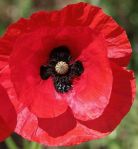 The field poppy, Papaver rhoeas, on which the remembrance poppy is based, has long been associated with armies fighting in Europe.
The flowers often overgrew the mass graves left by battles, and this has been documented, at least back to a 1693 battle in the Netherlands between the French and English, as well as the battle of Waterloo, and of course WWI, where the enormous artillery bombardments completely disrupted the landscape. This destruction infused chalk soils with lime, and the Poppy thrives in that environment where their vivid colour can’t be missed in contrast to the surrounding disfigured terrain.
In closing, the themes for the poppy across the centuries, are for the most part nods to the underworld, sleep, funeral rites, and death, which seems like an appropriate symbol for all of the people who’ve died fighting wars.
- https://en.wikipedia.org/wiki/Silk_road
- https://en.wikipedia.org/wiki/Sumer
- https://en.wikipedia.org/wiki/Poppy_goddess
- https://en.wikipedia.org/wiki/Diana_(mythology)
- https://en.wikipedia.org/wiki/Opium
- http://melbakes.pl/baza-wiedzy/pochodzenie-i-historia-maku/
- https://en.wikipedia.org/wiki/The_Wonderful_Wizard_of_Oz
- Plant Lore, Legends and Lyrics – Embracing the Myths, Traditions, Superstitions, and Folk-Lore of the Plant Kingdom. BY RICHARD FOLKARD – Published 1884
- Red Poppies – By David Rhodes Sparks – Published 1918
- https://en.wikipedia.org/wiki/Poppy_seed
- https://en.wikipedia.org/wiki/Remembrance_poppy
Grow note
Poppy seeds like the cool of early spring or autumn to be planted.
They don’t like to be transplanted due to their rather long taproot. If you must move a Poppy, make sure to get as much soil around them as possible. Otherwise, it dries out in no time and you’re left with a dead plant. I say this from personal experience. : (
They sure are showy once they’re established. A real treasure in the garden!

Field of red poppies – S. Shelton, Postcard, ca 1903 Public Domain





 wallflowerstudiogarden.com