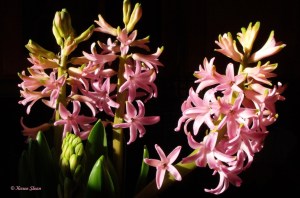
Along with beauty and scent, Hyacinth flowers offer us myth and folklore, too!

Several weeks ago we hosted a wonderful family gathering at our home. Because of this, we were the lucky recipients of beautifully potted, forced hyacinths.

A Hyacinth, aka Hyacinthus, are bulbous, perennial plants, native to the eastern Mediterranean from the south of Turkey to northern Israel.

Here in Canada, we plant these hardy bulbs in the fall.  Come springtime, they grow to a height of 6-8 inches, appearing in our gardens after the snow and (hopefully) any frost has gone.

The Hyacinth was so popular in the 18th century that more than 2,000 cultivars were grown in the Netherlands, its chief commercial producer.

I enjoyed the heady aroma of these spectacular spring flowers very much over the course of the following week. When heading upstairs to our kitchen where the flowers were on display, I could smell them before seeing them. Admittedly, I could get used to that!

After such a long winter, (hopefully behind us now, but with today’s weather, that’s questionable), it was a pure feeling of joy to experience the sight of those blooms and their exquisite perfume.

‘The Death of Hyacinth’ by Giovanni Battista Tiepolo. – Museo Thyssen-Bornemisza, Madrid. Public Domain

These lovely, highly scented Hyacinths earned their name to honour a youth, accidentally killed by his friend and lover, the Greek god Apollo.

Homer wrote that the flowers appeared when the drops of blood from this fallen fellow met the ground.

Many floral enthusiasts like me are curious about botanical symbolism and the history behind flower names.

Any legendary correlations, little known details, quips, lore and tales about the natural world, linking all of it together, are usually a delight to discover!

I suspect any plant one could name, be it flower or tree, has a yarn spinning behind it!

With relation to the natural world, classical literature linked flowers to the gods via epic poems and tales that Homer, Ovid and others have spun, explaining beauty and the creation of so many botanical species.

Others fairy tales include life lessons that even today point out human frailties. Our contemporary society can still learn from these relatable plots as we still manage to trip over our own egos from time to time, not unlike the characters from many a fable.

With that in mind, it’s no wonder to this day we still offer floral tributes honouring people in our lives, marking every event from birth to death, and everything in between, or just because!

As you can see, cats aren’t immune to botanical beauties either. Even my cat Luna likes to stop and smell the flowers!

Have a good weekend, and Happy Gardening!
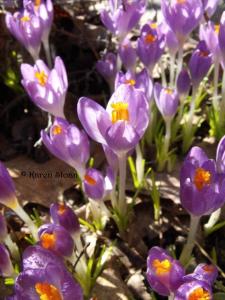
The first flowers of spring – Friday Flowers – Crocus

Happy to share that the lovely little crocus flowers are holding their heads up high in the garden.

The first blooms in spring offer any gardener something to cheer about!

One clump of crocus has a view (of what I’m calling a small glacier) on the driveway.

Thankfully milder weather has arrived, so that snow is melting fast!

Crocus, like the narcissus flower, has its own connection to Classical Greek mythology.

It turns out Crocus was a mortal youth who, because he was unhappy with his love affair with a nymph named Smilax, he was turned into this plant by the gods.

In another variation of the myth, Crocus was said to be a companion of Hermes. He was accidentally killed by Hermes in a game of discus. He was so distraught about it that he transformed Crocus’ body into a flower.

A fitting tribute!

Have a lovely weekend, everyone!


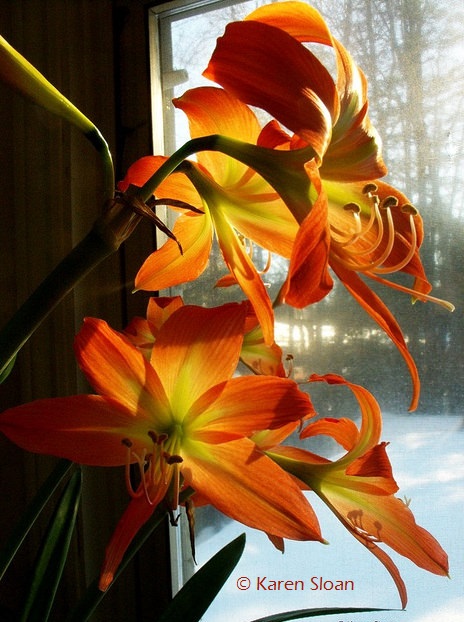
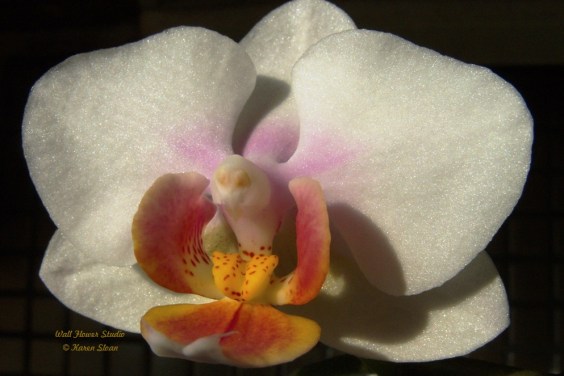
Flowers in bloom on WordlessWednesday – Orchids and Amaryllis brighten up a dreary February day

Flowering Friday for Fall.. the last hurrah of this year’s blooms

perennial mums

Sharing a smattering of perennials still clinging to life in our October garden.

With the frost coming soon, and with winter’s impending arrival, the garden will soon be put to bed, the last of the leaves will be raked, (oak trees shed leaves a little later), so the time has come to look back at all that was accomplished this year, and to anticipate & plan new projects for next spring.

In the meantime, I’ve harvested many seeds, (still yet to be packed and labelled), steeped rosehips, lavender, and arnica flowers, (among others) in oils for our botanical apothecary products, and have collected an assortment of herbs for our small batch vinegar & spice rubs. A busy time of year for everyone! Gathering for the winter is what fall is all about. Now it’s time to offer gratitude, and just enjoy the garden for what it offered me this past year

~ Happy gardening!


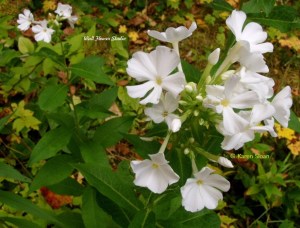
Hardy phlox

Lovely light purple asters

A very late blooming Sweet William

The last bee I’ll likely see this year, on the sedum


Hydrangea, both white and pink


Chelone lyonii, Pink turtle head – A lovely native species offering autumn blooms

The beautiful Chelone lyonii ‘Hot Lips’ also goes by the common name of pink turtlehead. It blooms from July straight through to October, so it’s a terrific addition to any garden.

Chelone comes from the Greek word meaning tortoise because each blossom obviously resembles, without too much imagination, a turtle’s head.

A great perennial for late summer colour that doesn’t much like excessive heat, it will tolerate full sun if its feet are kept cool. The flowers are primarily pollinated by bees, but the Ruby-throated Hummingbirds will often visit them as well. The foliage of this plant is known to be bitter so it’s avoided by Deer and other herbivores. In my own experience the deer have yet to touch the Chelone, so this species is something to cheer about by any rural gardener!

Lucky to have this plant in my garden due to a lovely share from another local gardener, in the six or so years since it’s established, the plant has multiplied from one single flowering stem into more than a dozen. With its strong stems, the clump doesn’t flop over after a rainstorm.

It’s worth noting that there’s a white flowering species called Chelone glabra that I’d like to get my hands on! A host plant for the endangered Baltimore Checkerspot butterfly, and like their pink cousin they too will thrive in damp locations and shady glades.

It’s my hope to collect many seeds this year. I’ll be able to offer them online at my Etsy shop. The pollinators did their jobs well, seed heads are forming, and with a little luck the mild weather we’re currently experiencing means they’ll ripen before the first hard frost. Then I can get my hands on some! Culture/Info:

  • Foliage: Herbaceous smooth-textured.
  • Requires consistently moist soil.
  • Propagation Methods: By dividing the root-ball or from seed.
  • Direct sow outdoors in fall or early spring.
  • Stratify seeds if sowing indoors.
  • Seed Collecting: Allow pods to dry on plant; break open to collect seeds.
  • Non-patented native perennial
  • Height: 24-36 in. (60-90 cm)

Thanks for visiting. Happy Autumn! : )