Upcoming art and gardening related workshops

Wall Flower Studio is offering two distinctly different upcoming workshops!
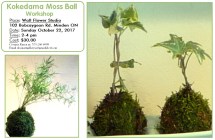
  1. Kokedama moss ball workshop

Based on ancient Japanese art, the literal translation of Kokedama is ‘moss ball’.
Kokedama is essentially any plant wrapped in moss and doesn’t require a container. The moss is the container!
Once created, Kokedama can sit anywhere or be hung from string.
Perfect for small spaces, as a table decoration, on the a windowsill, or hanging above one, this living art will enliven any living/office space.
Join Karen on Sunday October 22 to make and take home your very own Kokedama!
All supplies provided! Fee: $30.00


2.  Papier-mâché Animal Workshop

Interested in learning the art of Papier-mâché?
Join Karen for a fun-filled adventure & learn how to create your own 3D animal sculpture! (*There are 2 spots left)

It’s fun, messy, and it’s a 3 date class… One to build, one to cover with papier-mâché, and one to paint.

Dates: Sunday Oct. 29th + Sunday Nov. 5th + Sunday Nov. 12th. (2-4 p.m.)
Fee: $90.00 .. break it down to only 30 bucks per week. A great price for a fun class.
Come create, and don’t forget to bring along your inner child!


Please r.s.v.p. for either (or both) workshop(s) to: 705.286.6999sloanartgallery(at)gmail(dot)com (or) at Wall Flower Studio on Facebook.

Wall Flower Studio is located at 102 Bobcaygeon Rd. – Minden Ontario. (Directly across from the CIBC) – Please see map here on our website. Thank you!

Chelone lyonii, Pink turtle head – A lovely native species offering autumn blooms

The beautiful Chelone lyonii ‘Hot Lips’ also goes by the common name of pink turtlehead. It blooms from July straight through to October, so it’s a terrific addition to any garden.

Chelone comes from the Greek word meaning tortoise because each blossom obviously resembles, without too much imagination, a turtle’s head.

A great perennial for late summer colour that doesn’t much like excessive heat, it will tolerate full sun if its feet are kept cool. The flowers are primarily pollinated by bees, but the Ruby-throated Hummingbirds will often visit them as well. The foliage of this plant is known to be bitter so it’s avoided by Deer and other herbivores. In my own experience the deer have yet to touch the Chelone, so this species is something to cheer about by any rural gardener!

Lucky to have this plant in my garden due to a lovely share from another local gardener, in the six or so years since it’s established, the plant has multiplied from one single flowering stem into more than a dozen. With its strong stems, the clump doesn’t flop over after a rainstorm.

It’s worth noting that there’s a white flowering species called Chelone glabra that I’d like to get my hands on! A host plant for the endangered Baltimore Checkerspot butterfly, and like their pink cousin they too will thrive in damp locations and shady glades.

It’s my hope to collect many seeds this year. I’ll be able to offer them online at my Etsy shop. The pollinators did their jobs well, seed heads are forming, and with a little luck the mild weather we’re currently experiencing means they’ll ripen before the first hard frost. Then I can get my hands on some! Culture/Info:

  • Foliage: Herbaceous smooth-textured.
  • Requires consistently moist soil.
  • Propagation Methods: By dividing the root-ball or from seed.
  • Direct sow outdoors in fall or early spring.
  • Stratify seeds if sowing indoors.
  • Seed Collecting: Allow pods to dry on plant; break open to collect seeds.
  • Non-patented native perennial
  • Height: 24-36 in. (60-90 cm)

Thanks for visiting. Happy Autumn! : )

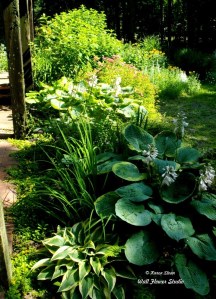
What’s growing in the July garden on a WordlessWednesday

Succulent container garden workshop at Wall Flower Studio

Succulent  Container Workshop – Saturday May 13th, 2017

Succulents come in an amazing array of colours and textures. Combining them in an unusual container for indoors or out is fun and easy to do.

In this workshop, participants will receive instructions, guidance and all the supplies to create a succulent garden in an unusual container to take home and nurture!
Make one as a gift for your mom, or keep it for yourself. 🙂

Class size is limited to 6 participants due to space requirements at the store.

– Date: Sat. May 13th at 3:30 – 4:30 pm
– Place: Wall Flower Studio – Minden Ontario
– Fee: 25$
– Please rsvp by May 9th. Thank you!

For more information, contact Wall Flower Studio at:  sloanartgallery (at) gmail (dot) com  -or-  705-286-6999 


*** Update: This workshop is now full. However, I’d be happy to hold another similar class on May 14th, (Mother’s Day) – Please get in touch if you’re interested – we’ll set something up! Thank you, Karen.

Wild leeks, aka ramps – Foraging for local food is always in season

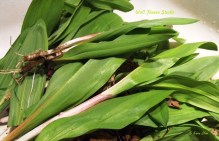
Wild Leeks, (Allium tricoccum) also known locally as ramps, grow wild and fairly abundantly here in our Eastern Ontario woods. It’s a spring delicacy to look forward to each spring, easily harvested before the blackflies arrive, and prized for their culinary value because they’re versatile to cook with, and so very tasty!

Foraging food from the woods is a joy everyone should experience and leeks never disappoint! There are dozens of ways to cook and eat them.  From omelettes to pesto, soups, sandwiches, salads, or even pickled, and that’s just for a start, foodies are coming up with new ways to enjoy leeks all the time.

With that in mind, and after perusing through some food photos on Pinterest, I was intrigued by Hassleback potatoes enough to make them. Thought they’d be the perfect candidate for my leeks harvest, too.

I washed the harvest, chopped them up, squeezed some lemon juice on them and voila.. (see photo!). I stuffed the potatoes, which look like edible accordions, along with the baked chicken thighs, which were also stuffed with mushrooms, goat cheese and the rest of the ramps. Delicious!

If you don’t have access to leeks where you are, I am offering several tasty culinary goodies from my harvest at the store. We’ll have our own hand made, locally sourced and locally created herbal Vinegars and condiments available again this spring, while supplies last,  which offer a taste of these delightful plants.

With regards to the leek pesto I created, silly me forgot to take a photo. In any case, here’s an easy recipe (below) that anyone can do.  It is lovely drizzled all over fresh pasta or spread on some crusty baked bread. Nice as a dip or on salad, too!

The directions are similar to a basil pesto, but with a substitution of leeks. One could experiment and add both!

Ingredients:

  • Dozen leek leaves
  • 3 garlic cloves
  • 3/4 cup of parmesan cheese grated
  • 1/2 cup of olive oil
  • 1/4 cup of pine nuts (roasted)
  • (optional) 1/2 cup of fresh parsley

Combine in blender and mix to a smooth paste. Enjoy!

Happy foraging, but please note: Don’t take more than necessary from the wild. Take a few, but leave most behind. – Thank you!